How to Choose the Best Laboratory Freezers?
Selecting laboratory freezers is not a simple temperature decision. Samples, workflows, energy use, and recovery performance all matter. In a busy laboratory, a door may open dozens of times daily. That routine changes real temperature stability. The CDC’s Vaccine Storage and Handling Toolkit specifies -50°C to -15°C for frozen vaccines and -90°C to -60°C for ultra-cold storage. These ranges are useful reference points, not universal laboratory rules. Material-specific protocols must lead. The WHO Laboratory Biosafety Manual also stresses controlled storage, monitoring, and documented procedures for biological materials.
Industry research adds another perspective. Grand View Research’s Laboratory Freezers Market Size, Share & Trends Analysis, 2024–2030, reports continuing demand from biobanking, pharmaceuticals, and clinical research. Meanwhile, My Green Lab’s Freezer Challenge materials emphasize maintenance, organization, temperature management, and energy reduction. The practical lesson is uncomfortable: the cheapest unit may cost more over time. Compare set-point accuracy, temperature uniformity, pull-down time, alarm visibility, backup power, service coverage, and usable volume. Ask for independent test evidence. An ultra-low-temperature freezer may protect irreplaceable specimens, yet consume substantial electricity. U.S. Department of Energy guidance supports evaluating laboratory equipment through lifecycle energy performance, not purchase price alone. Perfect selection is impossible. A defensible choice documents risk, validates capacity, and leaves room for honest review after installation. That is where this guide begins.
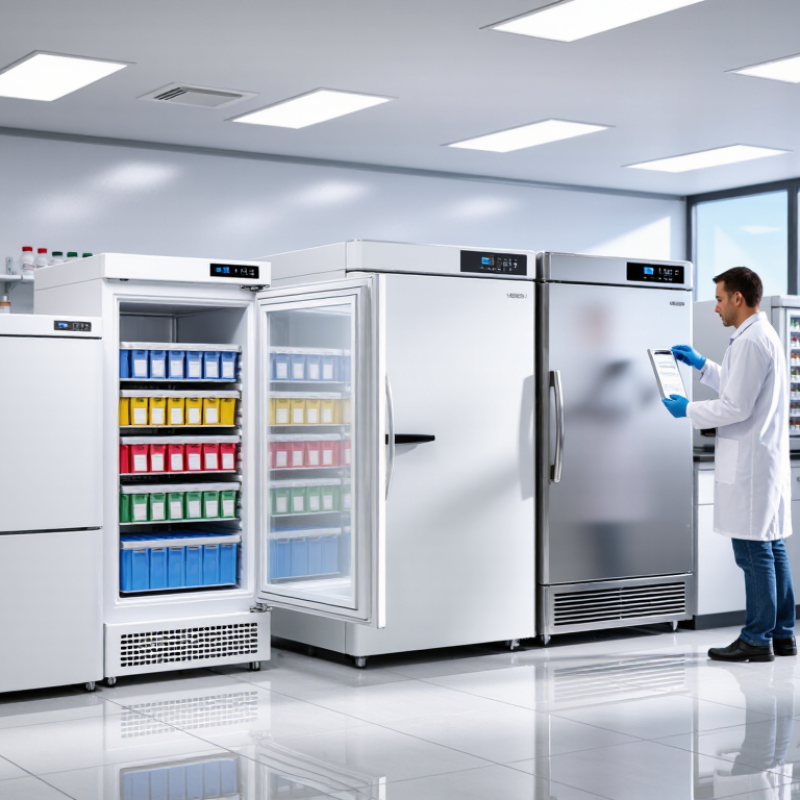
Set the Temperature Class: –20°C, –40°C, or –80°C by Sample Type
How to Choose the Best Laboratory Freezers?
Choosing a laboratory freezer begins with the sample, not the lowest temperature. A –20°C freezer suits many routine reagents, enzymes, and short-term biological materials. It is practical for daily access and usually easier to maintain. However, repeated door openings can create temperature swings. Check the actual temperature, not only the display.
A –40°C freezer offers a stronger margin for samples needing longer storage or greater stability. It may suit selected proteins, diagnostic materials, and research specimens with validated storage requirements.
At –80°C, sensitive nucleic acids, rare specimens, and long-term biobanks often receive better protection. Still, colder is not automatically better. Some materials can suffer from repeated freeze-thaw cycles, even at very low temperatures.
Review stability data, storage duration, container type, and access frequency before deciding. Use calibrated probes and map temperatures across the cabinet, especially near the door and upper shelves. Keep an alarm system active, and record recovery time after loading new samples. A backup power plan matters too.
In practice, the perfect class is not always obvious. A –80°C unit may waste energy when a validated –20°C protocol is enough. That judgment should be documented, reviewed, and occasionally challenged. One overlooked detail can be sample placement. Overfilled shelves restrict airflow and create uneven conditions.
Size the Cabinet: Compare Net Liters, Rack Capacity, and 10–20% Headroom
How to Choose the Best Laboratory Freezers?
Size the Cabinet: Compare Net Liters, Rack Capacity, and 10–20% Headroom
Cabinet size should begin with usable storage, not the advertised gross volume. Net liters describe available interior space after insulation, shelves, and cooling components. Rack capacity is more practical. It shows how many standard boxes, trays, or microplates the cabinet actually holds. A 700-liter freezer may fit fewer boxes than expected if shelves are narrow or poorly spaced.
Create a simple inventory model before comparing specifications. Record box dimensions, rack footprints, shelf clearance, and the number of samples per box. Then calculate current demand and expected growth. ISBER’s Best Practices, Fifth Edition (2021), emphasizes documented inventory control and capacity planning for repositories. That guidance supports using real inventory data instead of guessing from cabinet volume. A spreadsheet helps, but it can still be wrong.
Leave 10–20% headroom above the planned load. This space supports new samples, temporary transfers, and safer retrieval. It also reduces the temptation to compress boxes against shelves or airflow paths. I2SL laboratory energy guidance reports that ultra-low-temperature freezers can consume roughly 20–30 kWh per day. Poor organization can increase door-open time and operational waste. Check rack capacity twice. Small dimensional errors become expensive quickly.
How to Choose the Best Laboratory Freezers? — Size the Cabinet: Compare Net Liters, Rack Capacity, and 10–20% Headroom
| Cabinet Category |
Typical External Size
(W × D × H, mm) |
Usable Net Volume
(L) |
Standard Rack Capacity
(2-Inch Box Rack Positions) |
Planned Storage Load
(L / Rack Positions) |
Net-Volume Headroom |
Rack Headroom |
Planning Assessment |
| Compact Upright |
600 × 700 × 1700 |
240 |
8 |
205 / 7 |
14.6% |
12.5% |
Within 10–20% target |
| Medium Upright |
700 × 800 × 1950 |
400 |
16 |
340 / 14 |
15.0% |
12.5% |
Within 10–20% target |
| Large Upright |
850 × 850 × 2000 |
600 |
24 |
510 / 21 |
15.0% |
12.5% |
Within 10–20% target |
| Extra-Large Upright |
1000 × 950 × 2000 |
800 |
32 |
680 / 28 |
15.0% |
12.5% |
Within 10–20% target |
| Compact Undercounter |
600 × 650 × 850 |
100 |
4 |
90 / 4 |
10.0% |
0.0% |
Rack capacity is fully utilized |
How to read the table:
Net-volume headroom = (usable net volume − planned storage load) ÷ usable net volume.
Rack headroom = (available rack positions − planned rack positions) ÷ available rack positions.
The 10–20% allowance helps accommodate inventory growth, airflow clearance, packaging variation, and temporary sample accumulation. Always verify the freezer’s internal dimensions and rack compatibility before ordering.
Check Performance: Require ±1°C Stability and 9-Point Temperature Mapping
Choosing the best laboratory freezer starts with measured performance, not display claims. Require temperature stability within ±1°C at the selected setpoint. A freezer showing −80°C may still expose samples near the door to damaging fluctuations. Small changes matter when specimens remain stored for months.
Use calibrated data loggers during qualification. The CDC’s 2024 Vaccine Storage and Handling Toolkit recommends digital data loggers with accuracy of ±0.5°C and current calibration certificates. That tolerance supports a meaningful ±1°C stability requirement. A nine-point temperature mapping study adds practical evidence. Place probes across three horizontal positions and three vertical levels, including the center and areas near the door. Test the freezer empty and under representative load conditions. Record readings at short intervals during pull-down, routine operation, and door openings. WHO Technical Report Series No. 961, Annex 9, also emphasizes mapping storage areas to identify hot and cold spots.
Look for tight recovery after a door opening, not just a low average temperature. Ask for raw mapping records, probe serial numbers, calibration dates, and alarm response times. Review the worst location, because averages can hide it. I have seen qualification plans focus too heavily on the center shelf. That approach feels efficient, but it can miss the real risk. Some facilities also map only once. That is not enough when loading patterns, room temperature, or maintenance conditions change. Requalification should follow major repairs and documented environmental changes.
Assess ULT Efficiency: Compare kWh/Day, Heat Rejection, and CO₂ Backup
Choosing a laboratory freezer requires more than checking its storage volume or lowest temperature.
For ultra-low-temperature units, compare energy use in kWh per day under similar conditions. Ask whether the figure comes from an empty chamber, a full load, or a controlled test. A freezer using 12 kWh/day may perform differently in a warm laboratory with frequent door openings. Record actual readings for several days.
Heat rejection matters because nearly all consumed electricity becomes heat released into the room. This can increase air-conditioning demand, especially when several freezers operate together. Check the specified heat output, condenser design, and room temperature limits. Leave adequate clearance around ventilation panels. A simple power meter and room thermometer can reveal conditions that brochures may not show. My first estimate is rarely perfect.
CO₂ backup adds protection during power loss or mechanical failure, but it is not a substitute for efficient operation. Review the backup system’s injection rate, alarm timing, cylinder capacity, and expected holdover period. Calculate how long the stored CO₂ can protect samples at the actual chamber size and temperature. Confirm that the room has suitable ventilation and oxygen monitoring where required. Test alarms and backup transfer under supervision. One overlooked detail is cylinder replacement planning; an empty backup system offers no protection.
Confirm Compliance: Align With ISO 15189, IEC 61010-2-011, and USP <1079>
Choosing the best laboratory freezer starts with compliance, not capacity or a lower purchase price. ISO 15189:2022 requires laboratories to control equipment, calibration, maintenance, and related records. Therefore, check whether the freezer supports documented temperature mapping, traceable calibration, and preventive maintenance. A crowded freezer creates risks. Leave space around boxes, keep shelves labeled, and record loading patterns.
IEC 61010-2-011 addresses safety requirements for refrigerating equipment used in laboratory environments. Inspect door seals, electrical protection, alarms, and restart behavior after power failure. USP <1079> also emphasizes controlled storage, monitoring, alarm response, and documented handling of temperature excursions. The WHO estimates that up to 50% of vaccines may be wasted annually because of temperature-control failures, showing why monitoring cannot be treated as an optional feature. Source: WHO, Immunization Supply Chain guidance.
Do not trust the display alone. Use an independent calibrated probe, review alarm history, and test recovery after a simulated door opening. In practice, small details matter: a probe placed near the evaporator may not represent the sample zone. One weakness in many purchasing checklists is focusing on the lowest recorded temperature. Stability matters more than a single impressive number. Ask suppliers for mapping protocols, uncertainty data, service intervals, and evidence of IEC testing. Keep every certificate accessible for audits. A freezer can look reliable and still lack defensible records.