How to Choose the Right Lab Equipment for Your Experiments?
Choosing the right lab equipment is essential for successful experiments. The right tools can enhance precision and efficiency. Lab equipment varies widely, from basic tools to advanced machinery. Each type serves a specific purpose and function, helping researchers achieve accurate results.
When selecting lab equipment, consider your experiment's specific needs. Will you need basic glassware, or advanced analytical devices? The choice can impact outcomes significantly. Moreover, cost is a crucial factor. High-quality equipment often comes with a steep price tag. Reflect on your budget while ensuring you don't compromise essential features.
Additionally, remember that not every researcher has access to the latest technology. Some may still rely on traditional tools. This often leads to questions about reliability and accuracy. Ultimately, the key lies in finding a balance between innovation and practicality. The right lab equipment can elevate your research, but it requires thoughtful consideration.

Understanding the Different Types of Lab Equipment Available
When selecting lab equipment, understanding the various types is essential. Glassware is fundamental. Beakers, flasks, and test tubes all serve distinct purposes. For example, beakers are great for mixing solutions. Flasks can handle reactions that require swirling without spilling.
Next, consider instruments like pipettes and spectrophotometers. Pipettes allow for precise liquid measurements. A spectrophotometer analyzes light absorption in samples. However, the choice of instruments depends heavily on the experiment's specific needs. This decision can be challenging.
Moreover, safety equipment shouldn't be overlooked. Items like goggles and gloves protect you from chemical hazards. It's easy to forget these essentials. In the rush of an experiment, some may not prioritize safety. Reflecting on equipment choices is critical for effective lab work. Each piece of equipment plays a role in ensuring accurate results.
Understanding the Types of Lab Equipment
Assessing Your Experiment's Specific Requirements and Goals
Choosing the right lab equipment begins with understanding your specific experiment's goals. Take a moment to define what you want to achieve. Are you measuring accuracy, efficiency, or perhaps data range? Each experiment has unique needs. This clarity helps narrow down your choices.
Also consider the scale of your experiment. Is it a small-scale test or a larger study? This affects the type and quantity of equipment you will need. Sometimes, we assume all experiments require high-end tools. This isn't always true; simpler options may suffice. Think through what you actually require versus what you think is necessary.
Don't overlook the budget constraints. High-quality equipment can be costly, yet essential for some studies. However, consider alternatives like renting or sharing resources with other labs. Reflect on past equipment choices, learning from what worked and what didn't.
Equipment selection involves a careful analysis, requiring time and critical thought. Sometimes mistakes lead to unexpected insights. Keep evaluating your requirements throughout your research journey.
Evaluating Quality and Precision in Laboratory Instruments
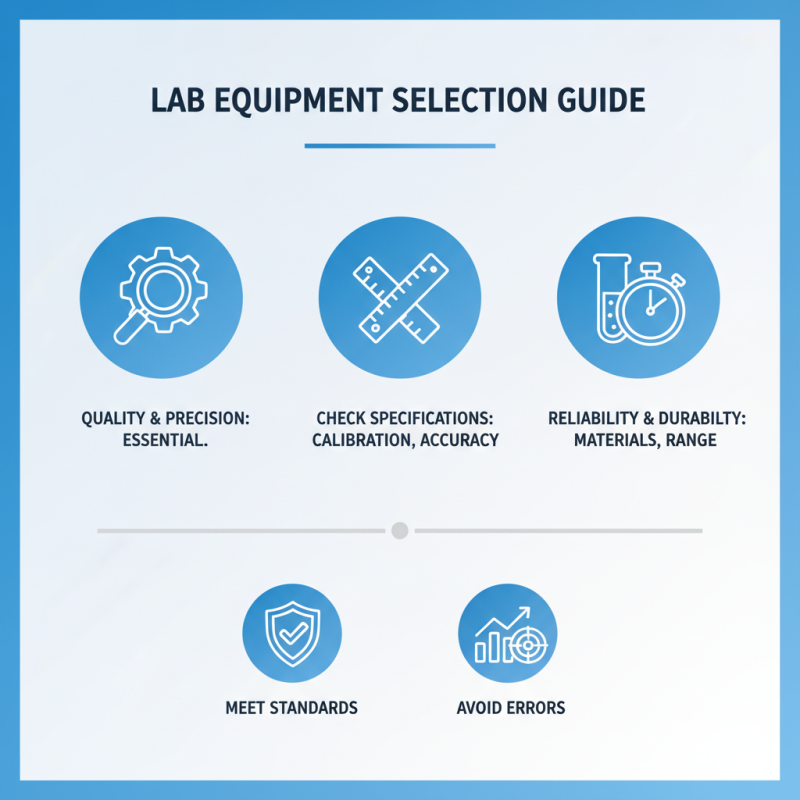
When selecting lab equipment, quality and precision are paramount. Instruments should meet specific standards to ensure reliable results. Check detailed specifications before making a decision. For example, look at calibration methods and the precision of measurements. Knowing the measurement range can help you avoid tools that will not meet your needs. Also, consider the materials used in the construction. They can affect both durability and accuracy.
Precision is about more than just numbers. Sometimes, a device can seem precise but may not be in real-world use. User experience plays a crucial role. How easy is it to use the instrument? Does it require frequent adjustments? Take time to read user feedback where available. A low-cost item can often result in inaccuracies. Sometimes, it's better to invest in quality over a lower price.
While high-end instruments may offer refined precision, they can be complicated. Not every lab has the same requirements. A balance between simplicity and performance is crucial. Evaluate your project goals. Ensure your equipment aligns with those objectives. Remember, precision is a moving target. Continually assess your needs as projects evolve.
Considering Budget Constraints and Cost-Effectiveness
When selecting lab equipment, budget constraints often come into play. It’s essential to balance quality with cost. A high price tag does not always guarantee superior performance. Some equipment may meet your needs without breaking the bank. Therefore, careful research is vital to find cost-effective options.
Consider the specific requirements of your experiments. Are you looking for precision or durability? Sometimes, opting for a slightly less advanced model can still yield satisfactory results. It is crucial to assess long-term expenses, such as maintenance and support. These costs can accumulate, affecting your overall budget.
Don't overlook the potential need for future upgrades. Equipment that seems affordable now may fall short later. Investing in slightly more expensive, yet versatile tools might save money in the long run. Be willing to reflect on your choices and ask if you're truly maximizing your budget.
How to Choose the Right Lab Equipment for Your Experiments?
| Equipment Type |
Cost ($) |
Maintenance Cost ($/year) |
Average Lifespan (years) |
Usage Frequency (times/week) |
| Microscope |
800 |
100 |
10 |
15 |
| Centrifuge |
1500 |
200 |
8 |
10 |
| Pipettes |
300 |
50 |
5 |
20 |
| Spectrophotometer |
1200 |
150 |
7 |
12 |
| Incubator |
2000 |
250 |
10 |
5 |
Researching and Comparing Vendor Reputation and Equipment Support
When choosing lab equipment, vendor reputation is crucial. A reliable vendor often has positive feedback from various users. Check online reviews and forums. Look for discussions on technical support. A knowledgeable support team can help troubleshoot equipment issues. Accessibility matters too. Vendors with prompt responses are more favorable.
Comparing support services is essential. Some vendors offer extended warranties and training sessions. These can be invaluable when using complex tools. Pay attention to service agreements. Clarity in terms can prevent misunderstandings later. Be wary of vendors with vague support promises. Communication can reveal a lot about their commitment.
After thorough research, you might still face choices that seem right but aren't optimal. Equipment may look good on paper yet fail in practice. Talk to peers who have used the equipment. Their insights can illuminate potential pitfalls. Remember, the best choice isn't always the most popular. It’s about fitting your specific needs.