Explore cutting-edge articles on laboratory products, industry innovations, and research trends with Lab Consulting.
Choosing a Steel Security Door supplier in China requires more than comparing prices and attractive photographs. The right manufacturer should demonstrate controlled production, tested materials, and consistent communication. Buyers may need doors for apartments, villas, offices, factories, or protected service areas. Each setting demands a different balance of strength, appearance, insulation, fire performance, and access control.
Details matter. A galvanized steel sheet, reinforced hinges, accurate frames, and dependable locks can influence daily safety. However, thickness alone does not prove quality. Welding, powder coating, dimensional tolerances, packaging, and installation guidance deserve equal attention. Experienced suppliers should explain their material grades, production stages, testing methods, and quality inspection records clearly. They should also provide samples, technical drawings, and current certification documents when applicable. Buyers must verify those documents independently, because a polished catalog can hide practical weaknesses.
This guide reviews China’s leading steel security door manufacturers and suppliers through realistic purchasing criteria. It considers factory capability, customization, lead times, export experience, after-sales support, and project communication. A reliable supplier should answer technical questions without vague promises and identify limitations before production begins. No supplier is perfect. Delays, color differences, or fitting issues may still occur, especially with customized orders. That is why written specifications, approved samples, inspection points, and clear warranty terms remain essential. The goal is not merely to find a low-cost door. It is to select a dependable partner whose products perform consistently in real buildings.
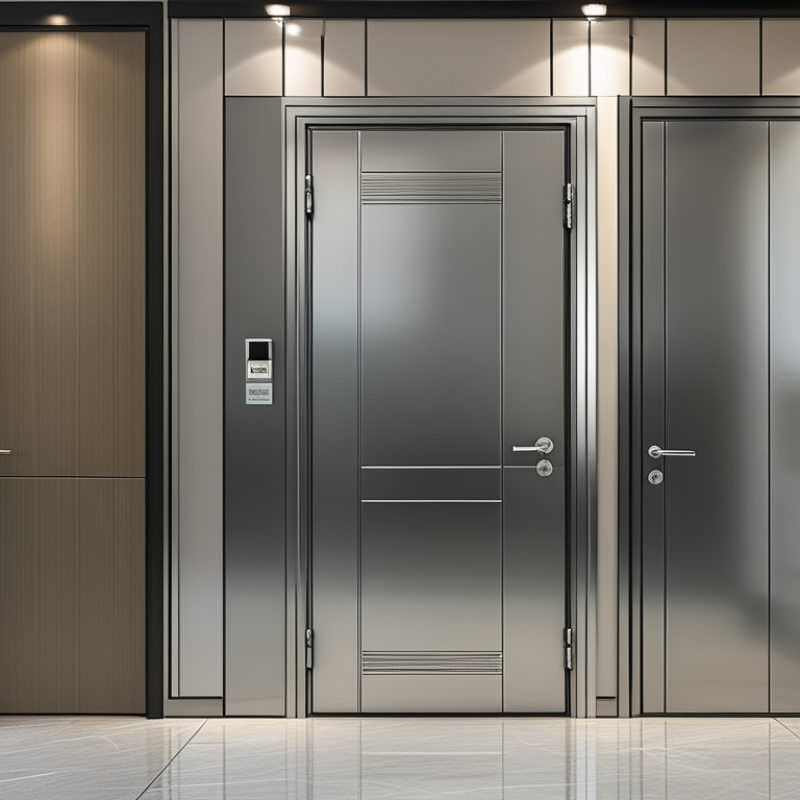
China’s steel security door manufacturers produce several practical types for homes, apartments, offices, and industrial buildings. The commonest is the single-leaf door, usually made with galvanized steel skins, reinforced frames, and multi-point locks. Double-leaf models suit wider entrances, although their meeting edges need careful alignment. Fire-rated steel doors use mineral cores, intumescent seals, and self-closing hardware. They are commonly specified under China’s GB 12955 standard, but certification must match the project’s actual fire rating.
Insulated steel doors reduce heat transfer through polyurethane or rock-wool cores. Acoustic versions add layered seals and heavier panels for hotel rooms, recording spaces, and apartments. Glazed security doors provide visibility through laminated or fire-rated glass. Some entrance doors combine steel reinforcement with decorative woodgrain or powder-coated finishes. According to the World Steel Association’s 2025 World Steel in Figures, China produced about 1.005 billion tonnes of crude steel in 2024. That supply base supports wide customization and stable component sourcing. It does not guarantee consistent workmanship.
China’s National Bureau of Statistics reported an urbanization rate of 67.00% in 2024, sustaining demand for residential and commercial entrance systems. Export buyers should compare door-leaf thickness, frame depth, core density, hinge design, and test documentation. A thicker panel is not automatically safer. In my inspection experience, poor frame anchoring often weakens an otherwise strong door. Specification mistakes remain surprisingly common.
China Top Steel Security Door Manufacturers and Suppliers
Key Standards for Evaluating Chinese Door Manufacturers
A reliable manufacturer should show more than attractive product photos. Ask for steel grade, sheet thickness, frame structure, and core material in writing. The details matter. Check whether door dimensions, hinges, locks, and thresholds match your project drawings. A clear technical datasheet reflects stronger engineering control.
Request test reports from independent laboratories. Match each report with the exact door model, not a similar sample. Relevant standards may cover forced-entry resistance, fire performance, insulation, or corrosion protection. Requirements vary by market. Confirm the testing scope before accepting any certificate. Ask for evidence. A logo alone proves little.
Factory evaluation should include production records, welding quality, coating thickness, and packing methods. Inspect several units, including unfinished frames and finished doors. Clean welds should have consistent penetration and minimal sharp edges. Suppliers should also explain batch traceability, inspection checkpoints, spare parts, and warranty handling. Communication deserves attention. Slow or vague answers can create costly mistakes later. A factory visit helps, but it is not perfect. One visit may show an unusually prepared production line. Compare samples, records, and real delivery history. Some buyers focus too heavily on price. That choice often overlooks installation tolerances and after-sales support. Ask for a pre-production sample and approve every visible detail before bulk manufacturing.
China’s steel security door industry is concentrated in several manufacturing regions, each with distinct strengths.
Zhejiang, especially Yongkang, is known for mature metalworking skills and broad supplier networks. Many factories there produce residential doors, fire-rated models, and customized entry systems. The region benefits from nearby hardware, lock, coating, and packaging suppliers.
Guangdong, including Foshan and surrounding cities, offers strong access to export ports and advanced surface-treatment services. Manufacturers often focus on modern designs, stainless steel details, and project-based orders. Hebei also has an important role in steel processing and cost-focused production.
However, regional labels can mislead. Factory capability differs widely within the same city. Buyers should inspect welding quality, door-core materials, frame thickness, coating adhesion, and test documentation. A polished showroom is not enough evidence. My practical experience suggests that sample inspection reveals more than catalog claims.
Ask for production photos, material specifications, and recent test reports. Confirm whether the factory makes doors in-house or outsources key processes. Check hinges, seals, and locking points by opening and closing the sample repeatedly. Small defects often appear after several cycles. Be careful with unusually low quotations; savings may come from thinner steel or weaker internal reinforcement.
Selecting a reliable steel security door supplier requires evidence, not polished catalog images. The World Steel Association’s 2024 statistics recorded about 1.89 billion tonnes of crude steel production worldwide. That scale proves supply capacity, not door performance. Ask for steel grade, thickness, galvanizing method, welding procedures, and batch traceability. A dependable supplier should provide test reports for EN 1627 resistance classes or an equivalent local standard. Check the laboratory’s accreditation carefully. A certificate logo alone is weak evidence.
Visit the factory when possible. Inspect steel storage, welding stations, coating lines, and final inspection records. The ISO Survey 2022 recorded more than one million ISO 9001 certificates worldwide. Certification supports process control, but it does not guarantee forced-entry resistance. Request hinge-cycle results, lock compatibility checks, dimensional tolerances, packaging photos, and installation instructions. Speak with recent commercial buyers, not only references chosen by the supplier. Ask how defects are handled and how quickly replacement parts are delivered. Real details matter.
Do not ignore small inconsistencies. A door sample may look excellent while production batches vary. Compare several units from different dates. Confirm the door leaf thickness with a caliper, and inspect weld continuity around the frame. Warranty language also deserves careful reading. Some suppliers promise long coverage but exclude coating failure, hardware damage, or installation errors. Reliability is rarely perfect, and procurement decisions can still be wrong. A transparent supplier will admit limitations and explain how risks are controlled.
China remains the world's largest crude steel producer, providing a broad raw-material base for steel security door manufacturing. However, production scale alone does not prove supplier reliability. Buyers should also verify factory audits, product testing, material traceability, export experience, quality-control procedures, and compliance with applicable security-door standards.
China’s steel security door manufacturers and suppliers offer broad production capacity, but ordering requires technical clarity.
The World Steel Association reported 1,882.6 million tonnes of global crude steel production in 2024. China produced about 1,005.1 million tonnes, supporting a deep domestic material supply chain. Still, steel volume does not guarantee door quality.
A reliable order begins with a controlled specification sheet. State opening dimensions, steel thickness, galvanized treatment, core material, hinge position, lock preparation, finish, and packaging requirements. Ask for drawings before production. Customization should include samples or approved color panels. Short descriptions create expensive misunderstandings. An imperfect specification can delay installation.
Quality inspection should follow documented checkpoints. Inspect incoming steel certificates, panel dimensions, weld continuity, flatness, coating coverage, hardware operation, and carton protection. Request production photos and a pre-shipment inspection report. For security performance, reference the applicable test method, such as EN 1627 classifications, rather than accepting vague terms like “high security.” ISO 9001:2015 emphasizes controlled processes and documented evidence, which suppliers should demonstrate through inspection records. The OECD’s Due Diligence Guidance also supports traceable, risk-based supply-chain practices.
Measure twice. Record every deviation.
If a factory rejects an independent inspection, reconsider the order. A practical supplier may admit a weakness and correct it; polished promises are less useful than reproducible test results.
Subscribe to our newsletter and receive the latest news and exclusive insights every month. No spam.
LabConsulting GmbH and LC LabService GmbH are Austrian companies which cooperate with over 600 manufacturers and offers a selection of more than 180,000 products and various laboratory product and service solutions for our Labcustomers.
Die LabConsulting GmbH und die LC LabService GmbH sind österreichische Unternehmen, die mit über 600 global verteilten Herstellern zusammenarbeiten und mit einer Auswahl von mehr als 180.000 Produkten und verschiedenen Laborprodukt- und Servicelösungen unseren Parnern im Labor anbieten.
INSTOCK CATALOGOur services
Our services