Explore cutting-edge articles on laboratory products, industry innovations, and research trends with Lab Consulting.
Global buyers are reassessing Polypropylene Pipe as water, chemical, and industrial networks expand across demanding climates. Polypropylene is light, corrosion-resistant, and heat-weldable. Those advantages matter when containers cross ports, deserts, and freezing regions.
Recent market evidence supports this attention. Grand View Research valued the global polypropylene market at approximately USD 78 billion in 2023. It forecasts continued growth through 2030, driven by construction, packaging, and industrial applications. Fortune Business Insights also reports steady expansion in the broader plastic pipes market. However, these figures cover wider categories. They should not be treated as precise Polypropylene Pipe sales data. That distinction is easy to miss.
David A. Willoughby, author of Plastic Piping Handbook, offers a useful engineering reminder: “Selection must follow the application, not fashion.” His point remains practical. A pipe intended for chilled water needs different verification from one carrying aggressive chemicals. Wall thickness, pressure class, temperature, joint method, and ultraviolet exposure all deserve attention. Standards such as ISO 15874, EN 1555, ASTM F2389, and local certification rules can guide comparison. Yet compliance documents do not replace installation experience.
This 2026 guide examines PP-R, PP-H, PP-B, and reinforced polypropylene systems. It compares performance, operating limits, connection methods, and purchasing risks. Factory certificates matter. So do batch traceability, dimensional inspection, and supplier support after delivery. Some buyer assumptions will fail under field conditions. That is worth acknowledging. The cheapest quotation may become the most expensive decision when welding tools, fittings, or technical training are unavailable.
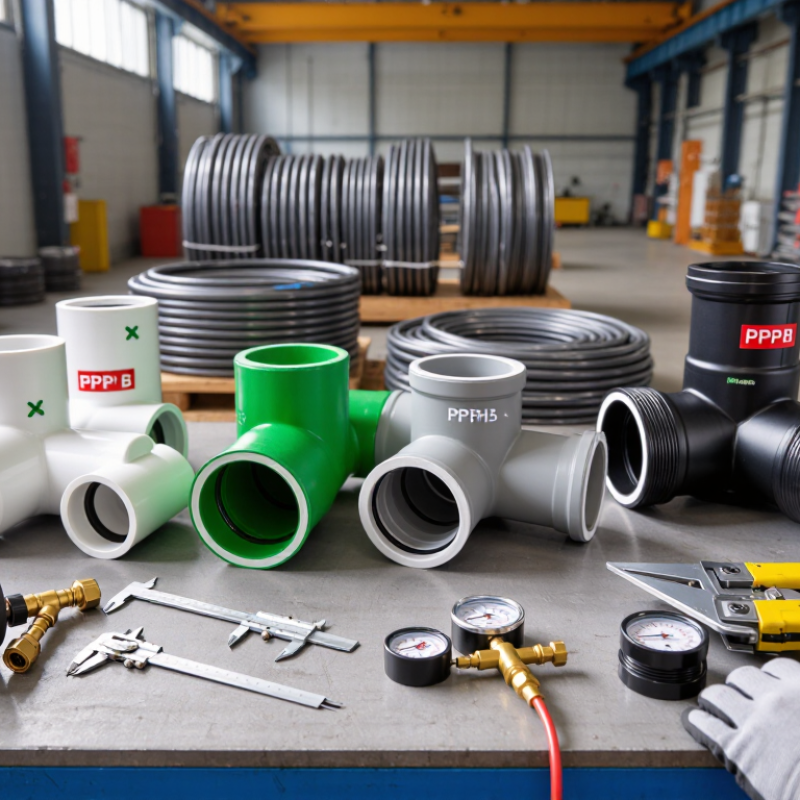
2026 Best Polypropylene Pipe Types for Global Buyers
ISO 15874 provides a useful framework for polypropylene piping in hot and cold water installations. PP-R remains a practical choice for domestic plumbing and many commercial systems. It offers reliable heat performance and supports heat-fusion joining. PP-RCT improves long-term pressure performance, especially at elevated temperatures. Its modified crystal structure can allow thinner walls or higher flow capacity. However, buyers should verify the exact pressure class and temperature rating.
PP-H is valued for stiffness, chemical resistance, and industrial service conditions. It may suit process water, but its pressure-temperature limits need careful review. PP-B generally provides good impact strength and flexibility. It is often considered for lower-temperature systems, drainage, or applications with movement. These categories are not interchangeable. Wall thickness, SDR, operating temperature, joint method, and installation quality affect real performance. A technically correct product can still fail after poor alignment or excessive thermal expansion.
Tips: Ask for ISO 15874 test evidence, material classification, dimensional tolerances, and pressure data. Check whether the documentation covers the complete pipe system, not only the resin. Inspect fusion surfaces before joining. Keep pipes shaded during storage, because prolonged sunlight can weaken unprotected material. I have seen buyers focus on price and overlook local water temperatures. That shortcut is difficult to correct later. Supplier experience matters, but independent inspection adds useful confidence.
For 2026 procurement, polypropylene pressure pipe should be judged by SDR, not PN alone. SDR is the ratio between outside diameter and wall thickness. A lower SDR means a thicker wall and usually higher pressure resistance. PN10, PN16, PN20, and PN25 describe nominal pressure classes, normally measured at 20°C. They are not permanent guarantees under every operating condition.
ISO 15874 defines requirements for polypropylene piping systems, while ISO 9080 evaluates long-term hydrostatic strength through testing and statistical extrapolation. Its 50-year design approach supports service-life calculations, but temperature changes the result sharply. A pipe rated PN20 at 20°C may need derating for continuous hot-water duty. Confirm the exact pressure-temperature table. Small details matter.
For many projects, SDR 11 can suit moderate pressure systems, while SDR 7.4 or lower may support higher ratings. However, the mapping differs by material grade, diameter, joint method, and safety factor. Technical listings such as PPI TR-4 provide useful hydrostatic design data for thermoplastic materials. Use certified values, not a supplier’s simplified chart. A neat table can mislead. I have seen buyers select PN25, then overlook surge pressure, installation stress, or weak fusion joints. The pipe was strong. The system was not.
2026 Best Polypropylene Pipe Types for Global Buyers?
Temperature performance separates a dependable polypropylene pipe from a poor specification. For cold-water distribution, PP-R retains corrosion resistance and low hydraulic roughness, but freezing remains a serious risk. Water expansion can split any pipe. At 70°C, pressure capacity falls as polymer strength decreases. ISO 15874 classifies 70°C hot-water service as Application Class 2, with an 80°C maximum operating temperature and a 95°C malfunction temperature. These limits are design references, not permission to ignore pressure derating. PPI TR-4 also uses long-term hydrostatic-strength data for thermoplastic pressure ratings. Buyers should request the complete temperature-pressure table, not only a nominal pipe rating.
Thermal cycling deserves more attention. Repeated movement from 10°C cold water to 70°C hot water can stress joints, supports, and wall penetrations. Unreinforced PP-R typically expands about 0.15 mm per metre for each 1°C change, although construction and reinforcement alter this value. A five-metre run may visibly move several centimetres during heating. That detail is easy to miss. Proper guides, expansion offsets, and qualified fusion work matter. ISO 15874 testing covers hydrostatic performance, dimensions, and system suitability, while project engineers should also review local installation standards. One uncomfortable point remains: laboratory cycles are cleaner than real buildings. Poor supports, trapped pressure, and uneven heating can shorten service life. Cite: ISO 15874 and Plastics Pipe Institute TR-4.
| Polypropylene Pipe Type | Cold-Water Performance | Performance at 70°C Hot Water | Thermal-Cycling Performance | Typical Linear Thermal Expansion | Best-Fit Applications | Key Buying Verification |
|---|---|---|---|---|---|---|
| PP-R Random Copolymer | Excellent Suitable for pressurized cold-water distribution when the pipe system is correctly rated and installed. | Suitable for hot-water systems Commonly used for domestic hot water at 70°C, subject to pressure class, design life, and applicable system standard. | Good with correct design Performs well when thermal expansion is managed with supports, offsets, loops, and correctly executed heat-fusion joints. | Approximately 0.12–0.18 mm/m·K for unreinforced PP pipe; verify the manufacturer’s declared value. | Potable cold water, domestic hot water, hydronic heating, and general building-services piping. | Verify compliance with ISO 15874 or the destination market’s equivalent standard, pressure class, SDR, hydrostatic strength, and hot-water design life. |
| PP-RCT Random Copolymer with Modified Crystallinity | Excellent Suitable for cold-water pressure service and often selected where higher pressure capability or thinner walls are beneficial. | Very good Well suited to 70°C hot-water duty when the complete system is rated for the required pressure, temperature, and service life. | Very good with correct design Strong option for repeated hot/cold operation, but thermal movement and joint workmanship remain critical. | Approximately 0.12–0.18 mm/m·K for unreinforced pipe; reinforced constructions can be substantially lower. | High-demand potable-water risers, hot-water distribution, larger commercial systems, and temperature-variable services. | Confirm that the pipe and fittings are specifically certified as a compatible PP-RCT system; do not infer performance from resin designation alone. |
| Glass-Fiber-Reinforced PP-R or PP-RCT | Excellent Suitable for cold-water distribution, with reduced thermal movement compared with many unreinforced constructions. | Suitable for 70°C service Appropriate for hot-water applications when the pressure-temperature rating applies to the complete reinforced pipe system. | Very good Lower axial expansion can improve behavior during repeated temperature changes and simplify support spacing. | Commonly around 0.03–0.06 mm/m·K, depending on reinforcement design, wall structure, and test method. | Long straight runs, hot-water risers, heating circuits, plant rooms, and installations where movement control is important. | Check reinforcement position, fusion compatibility, bending limits, support spacing, oxygen-barrier requirements, and certified pressure-temperature tables. |
| Aluminum-Reinforced PP-R | Excellent Suitable for pressurized cold-water service when the pipe is approved for the intended application. | Suitable for 70°C service Commonly selected for hot-water distribution because the metal layer greatly restricts axial thermal expansion. | Very good Low expansion supports stable performance during repeated heating and cooling, provided the aluminum layer is properly prepared before fusion. | Often approximately 0.02–0.04 mm/m·K; the actual value depends on layer construction and pipe design. | Exposed hot-water runs, long corridors, risers, heating systems, and applications requiring low visible movement. | Verify whether the product requires external or internal scraping, confirm oxygen-barrier performance, and use only compatible fittings and joining procedures. |
| PP-H Homopolymer | Very good Offers good chemical resistance and stiffness for many industrial cold-fluid applications. | Application-dependent Can be used for selected warm or hot industrial fluids, but suitability at 70°C depends strongly on pressure, chemical medium, and the product standard. | Moderate Requires careful support and stress analysis; impact resistance and low-temperature behavior must be checked for the service environment. | Typically within the broad PP range of approximately 0.10–0.18 mm/m·K, depending on formulation and construction. | Industrial chemical drainage, process-water lines, and selected pressure applications rather than general building hot-water systems. | Confirm chemical compatibility, impact requirements, pressure derating at 70°C, welding procedure, and compliance with the relevant industrial piping standard. |
| PP-B Block Copolymer | Good for designated systems Commonly used in drainage, soil, waste, and selected low-temperature applications; pressure service must be specifically approved. | Generally limited for pressurized 70°C water Do not select for continuous 70°C hot-water pressure service unless the complete product system is explicitly rated for it. | Good in suitable drainage duty Useful for temperature-variable drainage, but not a direct substitute for PP-R or PP-RCT hot-water pressure piping. | Commonly around 0.10–0.18 mm/m·K for unreinforced PP constructions; verify the declared product value. | Soil and waste systems, drainage, rainwater, and other applications defined by the applicable product standard. | Verify whether the product is a gravity-drainage or pressure-rated system; check maximum discharge temperature, joint type, and destination-market certification. |
Important: Temperature performance is system-specific. The values above are typical engineering ranges and selection guidance, not a substitute for the pipe manufacturer’s pressure-temperature tables, local codes, potable-water approvals, installation instructions, or project-specific thermal-cycling calculations.
For global buyers, polypropylene pipe selection should begin with the required standard, not only with pressure rating or price. PP-R and PP-RCT systems are commonly evaluated under ISO 15874 and EN 15874 for hot and cold water installations. These standards address materials, dimensions, performance, joints, and system testing. Check the exact edition and national adoption. Small wording differences can affect compliance.
For North American projects, ASTM F2389 is important for polypropylene pressure piping. It covers manufacturing requirements, dimensions, pressure performance, and testing methods. However, ASTM compliance does not automatically confirm drinking water safety. NSF/ANSI 61 evaluates materials and components that contact drinking water. Ask for current certificates, test reports, traceability records, and approved temperature-pressure tables. Paperwork matters.
A useful comparison is physical. Imagine a pipe carrying hot water behind a wall for twenty years. Poor fusion control may create a weak joint, even when the pipe itself meets the standard. Installation training and calibrated tools deserve the same attention as product certificates. I would not treat ISO, EN, ASTM, and NSF/ANSI as interchangeable labels. They serve different purposes.
Some buyers focus too heavily on the pipe body. That is a mistake. Fittings, valves, seals, and joint procedures can also determine system reliability. Requirements may vary by country, building type, and water-use category. Independent verification is wise when documents appear incomplete. A cheaper option can become expensive after retesting, replacement, or delayed approval.
Confirm flow demand first. Calculate internal diameter, velocity, pressure loss, and peak demand together. A pipe may look large but still restrict flow after fittings are installed.
Joining method changes both reliability and labor cost. Heat fusion creates clean, continuous joints when temperature, alignment, and cooling time are controlled. Electrofusion can help in restricted spaces, but it requires careful surface preparation and stable power. Mechanical transitions remain useful near metal equipment.
Climate deserves equal attention. In cold regions, allow for freeze protection and thermal movement. In sunny outdoor locations, specify suitable UV protection or shielding. Expansion loops may prevent stress around long exposed runs.
Certification checks should cover pressure rating, temperature range, potable-water contact, and fire requirements where applicable. Ask for current test reports, traceability records, and installation instructions. Requirements differ between markets. Verify them before ordering.
Cost comparisons should include fittings, welding tools, trained labor, freight, supports, testing, and future repairs. The cheapest pipe can become expensive after a difficult installation. I have seen projects underestimate fittings and inspection time. That mistake is common, and a spreadsheet rarely captures every site problem. Recheck the design with local installers before approving the final quantity.
Subscribe to our newsletter and receive the latest news and exclusive insights every month. No spam.
LabConsulting GmbH and LC LabService GmbH are Austrian companies which cooperate with over 600 manufacturers and offers a selection of more than 180,000 products and various laboratory product and service solutions for our Labcustomers.
Die LabConsulting GmbH und die LC LabService GmbH sind österreichische Unternehmen, die mit über 600 global verteilten Herstellern zusammenarbeiten und mit einer Auswahl von mehr als 180.000 Produkten und verschiedenen Laborprodukt- und Servicelösungen unseren Parnern im Labor anbieten.
INSTOCK CATALOGOur services
Our services